The Key Differences Between Business Owners Insurance and General Liability Insurance
Many business owners comparing business owners insurance and general liability insurance find the terms confusing — yet the differences are meaningful. Each type serves a distinct role in business risk management. Understanding those roles helps align coverage with real operational needs rather than buying protection based on terminology alone.
What Business Owners Insurance Covers
Business owners insurance (often called a BOP) is designed for smaller businesses that want a bundled solution combining property, liability, and interruption coverage. BOP packages typically cover property damage, equipment loss, and business interruption in one streamlined offering. Since the details vary both at the insurer level and the individual business needs, consulting with a reputable insurance agent is the best course of action.
What General Liability Insurance Covers
General liability insurance is more narrowly focused: it protects against third-party claims for bodily injury, property damage, and advertising or personal injury stemming from your business operations. Depending on your business operations, adding professional liability may provide protection that general liability policies ignore.
Key Differences Explained
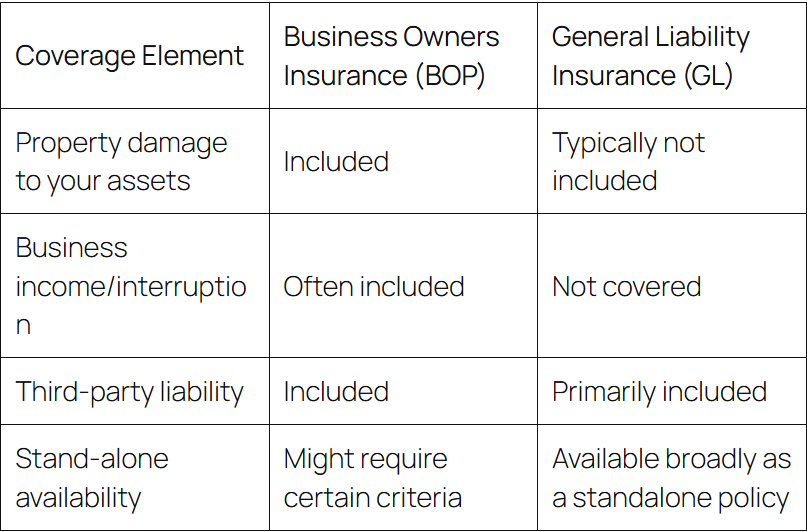
A summary by IRMI reinforces that general liability focuses on external legal exposures, while broader business policies cover additional operational risks. To help clarify, here are comparison points to keep in mind:
Which Fits Your Business Better?
Choosing the right coverage depends on your business structure. For example, cybercrime and liability are important aspects of business insurance that are often overlooked. Other considerations include:
If you own or lease commercial space, invest in equipment, or face business interruption risk, a BOP likely offers more targeted protection.
If your operations are service-based, have low physical assets, and focus primarily on third-party exposures, GL might suffice.
Short FAQ
Q: Can I purchase both business owners insurance and general liability insurance?
A: Yes. In some cases a business may layer coverage where necessary.
Q: Does a BOP always replace general liability insurance?
A: No. Although a BOP includes liability, GL alone does not cover property or income risk.
Q: Is general liability enough if I have no property assets?
A: Possibly—but it’s wise to review your exposure, especially with vendor contracts and service-based risks.
Key Takeaways
Business owners insurance bundles property, liability, and income protection; general liability focuses on third-party legal exposures.
A BOP may offer more comprehensive coverage for businesses with physical assets.
GL insurance remains essential for liability but does not protect your own property or income.
The right choice depends on your asset base, operational risks, and business profile.
Work with your independent agency to evaluate which option aligns best with your current business structure.
Disclaimer: This content is for informational purposes only and is not intended as legal or insurance advice.